
GEO Content Strategy Distinct from SEO (Theoretical Background and Practical Examples)
In various articles discussing content creation strategies for GEO optimization, you'll commonly see guidance like "write content following E-E-A-T and apply schema markup." While these elements are important, they were already important factors in SEO.
Therefore, it's difficult to view this as a GEO optimization strategy. The most important thing in content strategy for GEO optimization is not individual content creation but how to structure your website's content categories. This is because AI provides responses to users in a different way than traditional search engines.
In this article, we'll present a generative engine optimization content strategy for GEO based on papers analyzing LLM response generation processes and Google's published AI search operation methods.
*Terminology note
Since GEO means Generative Engine Optimization, the term 'GEO optimization' is technically redundant. However, because many users search for 'GEO optimization,' we reluctantly use the term 'GEO optimization' in this article.
SEO-Optimized Content vs. GEO-Optimized Content: What's the Difference?
In SEO, which focuses on keyword and page relevance, it was an effective strategy to operate websites as 'content department stores' covering as many keywords as possible.
As long as the content wasn't excessively irrelevant, it was possible to cover as many categories as possible while targeting high-volume keywords. This strategy actually achieved significant results. Companies like Salesforce, HubSpot, and Shopify publishing quote content can be understood in this context.
However, as confirmed in Google search patents, AI search services are asking us to become specialized 'brand boutiques' in specific fields rather than 'content department stores.'
How to Structure GEO Content Categories Different from SEO
According to Google patent US12158907B1 'THEMATIC SEARCH', Google Gemini 'fans out' a single search query into multiple related topics to gather materials. For example, if a user searches 'electric car purchase,' AI simultaneously explores all related topics like 'electric car price comparison,' 'electric car charging station locations,' 'electric car subsidy policies,' 'electric car battery lifespan,' 'electric car brand characteristics,' 'electric car maintenance costs,' 'electric car used car prices,' and 'electric car insurance rates.'
Website content categories should be structured to align with this AI operation method. Rather than comprehensively covering topics with different characteristics, categories should be organized with deeply related topics that can provide rich answers to a single search query. This allows achieving both thematic consistency and comprehensiveness of content. Let's compare the differences between SEO-optimized categories and GEO-optimized categories for a more intuitive understanding.
SEO-Optimized Category Example
- • SEO Strategy
- • GEO Strategy
- • AEO Strategy
- • B2B Marketing
- • AI Automation
'Content department store' approach with topics of different characteristics
GEO-Optimized Category Example
- • GEO Fundamentals
- • GEO Content Strategy
- • GEO Technical Optimization
- • GEO Performance Measurement
- • GEO Strategy Execution
'Specialized brand boutique' approach with comprehensive depth on one topic
The GEO category example above is our Answer Global blog's category structure. Through this strategy, the Answer Global website continues to be mentioned in AI searches related to 'Generative Engine Optimization' and 'GEO Consulting.' For those curious about more detailed category structure, please explore our blog directly.
How to Write GEO-Optimized Content
Among the most reliable GEO content hypotheses published to date, the strategies effective for increasing AI search visibility can be found in the paper "GEO: Generative Engine Optimization" by researchers from Princeton University and IIT Delhi. Here's a summary of the strategies that were effective in increasing AI search visibility according to the paper.
Paper Verification Results
Calculation Formula: (New Value - Baseline) / Baseline × 100
Baseline: 19.5 points (No Optimization - basic state without optimization)
Measurement Criteria: Position-Adjusted Word Count (mention position and frequency in AI search results)
Experiment Method: Input content with each GEO strategy applied and baseline content into generative AI like ChatGPT, Claude, etc. to compare mention rates in responses
Example: Quantitative statistics inclusion strategy → Achieved 27.8 points → (27.8-19.5)/19.5×100 = +41%
| GEO Optimization Strategy | Visibility Improvement |
|---|---|
Include quantitative statistics to enhance credibility | +41% |
Expert quotes to strengthen authority | +40% |
Explicit citations from credible sources | +28% |
Easy-to-read natural writing style | +25% |
Technical terminology to strengthen expertise | +15% |
Artificial keyword stuffing | -9% |
Practical Application Examples
Based on this paper's content, simply saying "add these 5 elements to create GEO-optimized content" might leave you uncertain about how to actually apply them, so we'll share examples that our Answer Global team is implementing.
Include Quantitative Statistics to Enhance Credibility
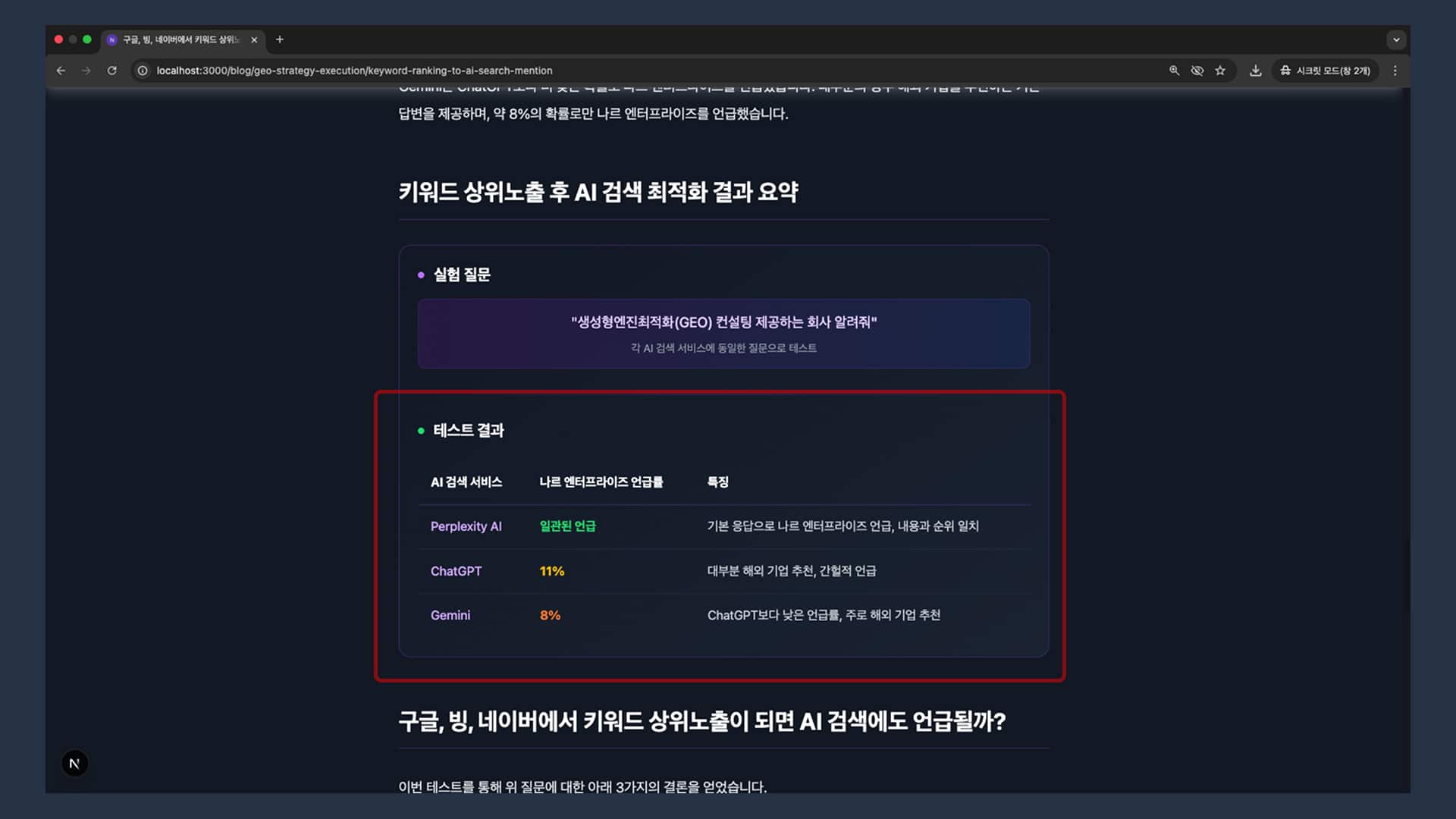
Include Quantitative Statistics to Enhance Credibility - Answer Global Application Example
Original link: Real GEO Success Case: Top Rankings on Google, Bing, Naver and AI Search Top Position
Expert Quotes to Strengthen Authority
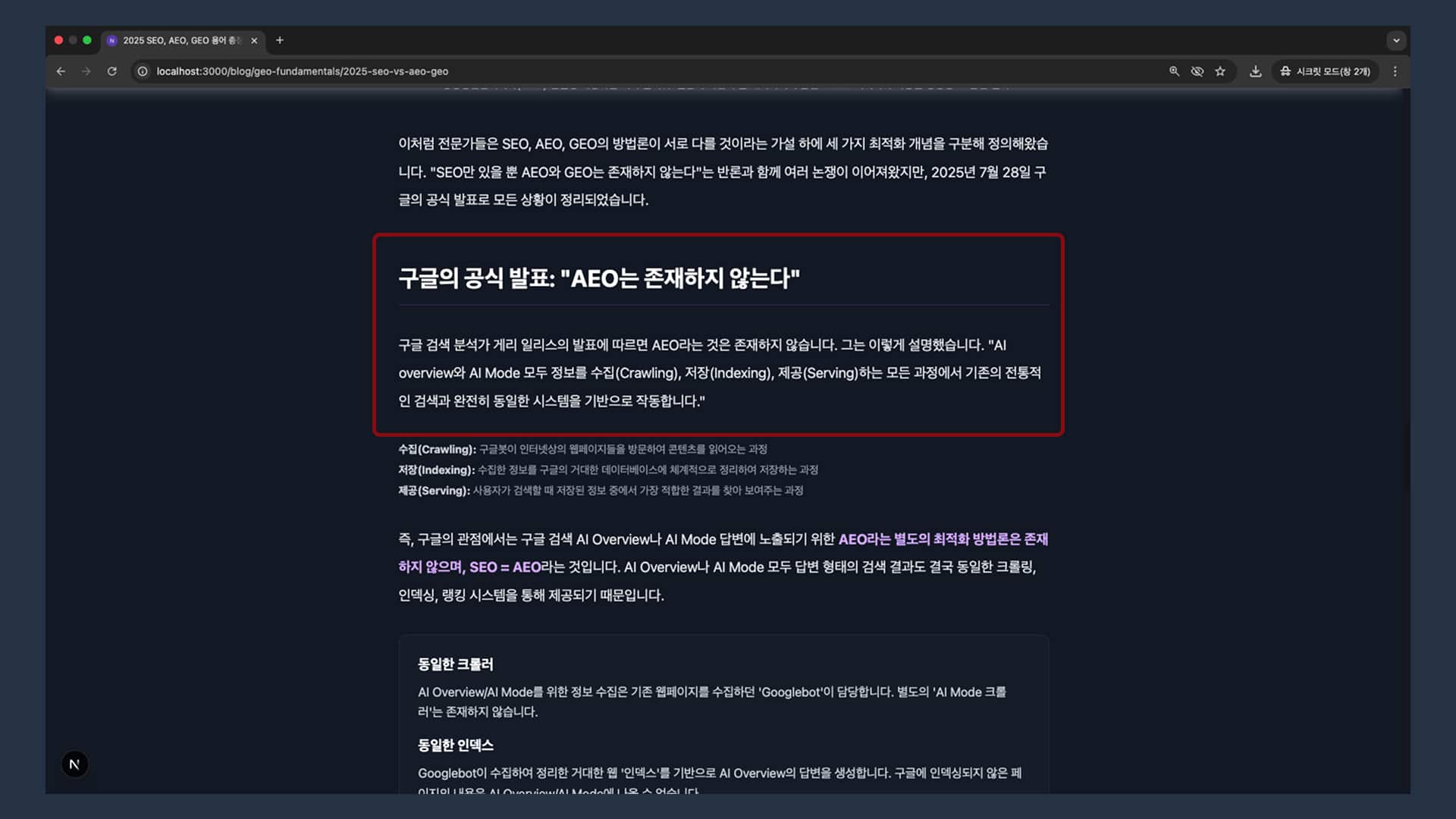
Expert Quotes to Strengthen Authority - Answer Global Application Example
Original link: A Comprehensive Guide to SEO, AEO, and GEO Definitions - Google's Official 2025 Standards
Explicit Citations from Credible Sources
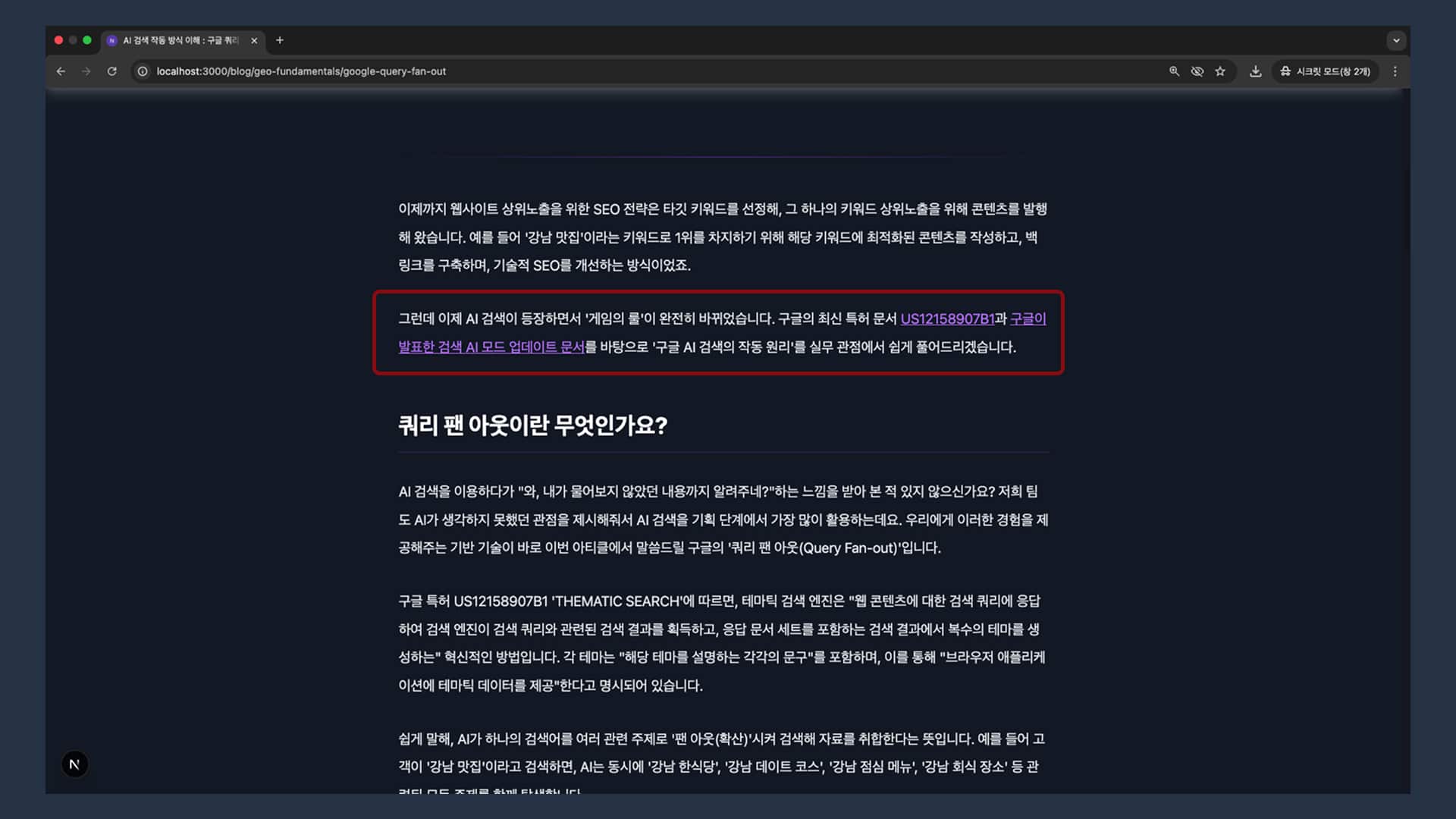
Explicit Citations from Credible Sources - Answer Global Application Example
Original link: AI Search Mechanism Analysis: An Easy and Professional Explanation of Query Fan-Out Technology
Easy-to-Read Natural Writing Style
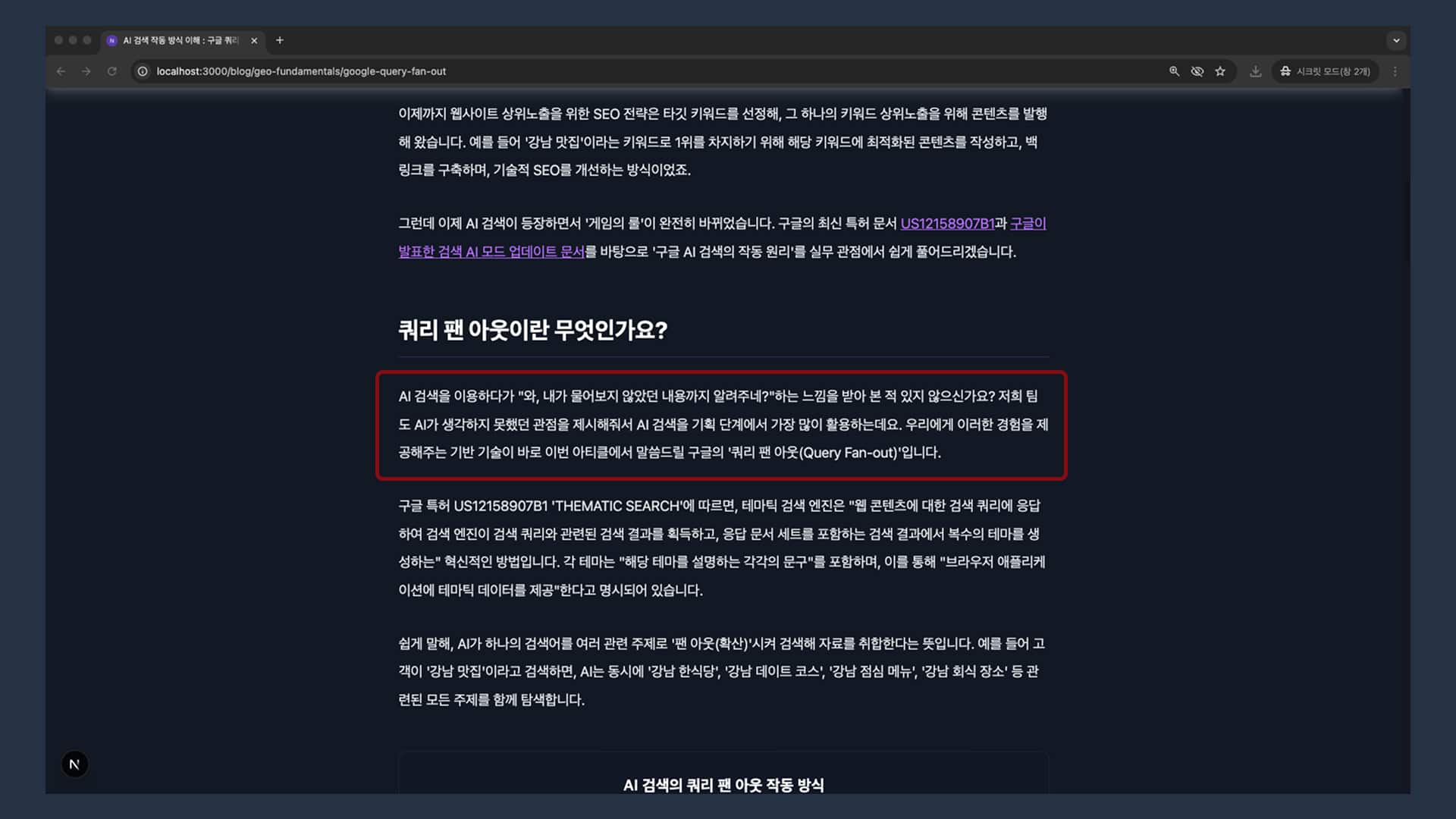
Easy-to-Read Natural Writing Style - Answer Global Application Example
Original link: AI Search Mechanism Analysis: An Easy and Professional Explanation of Query Fan-Out Technology
Technical Terminology to Strengthen Expertise
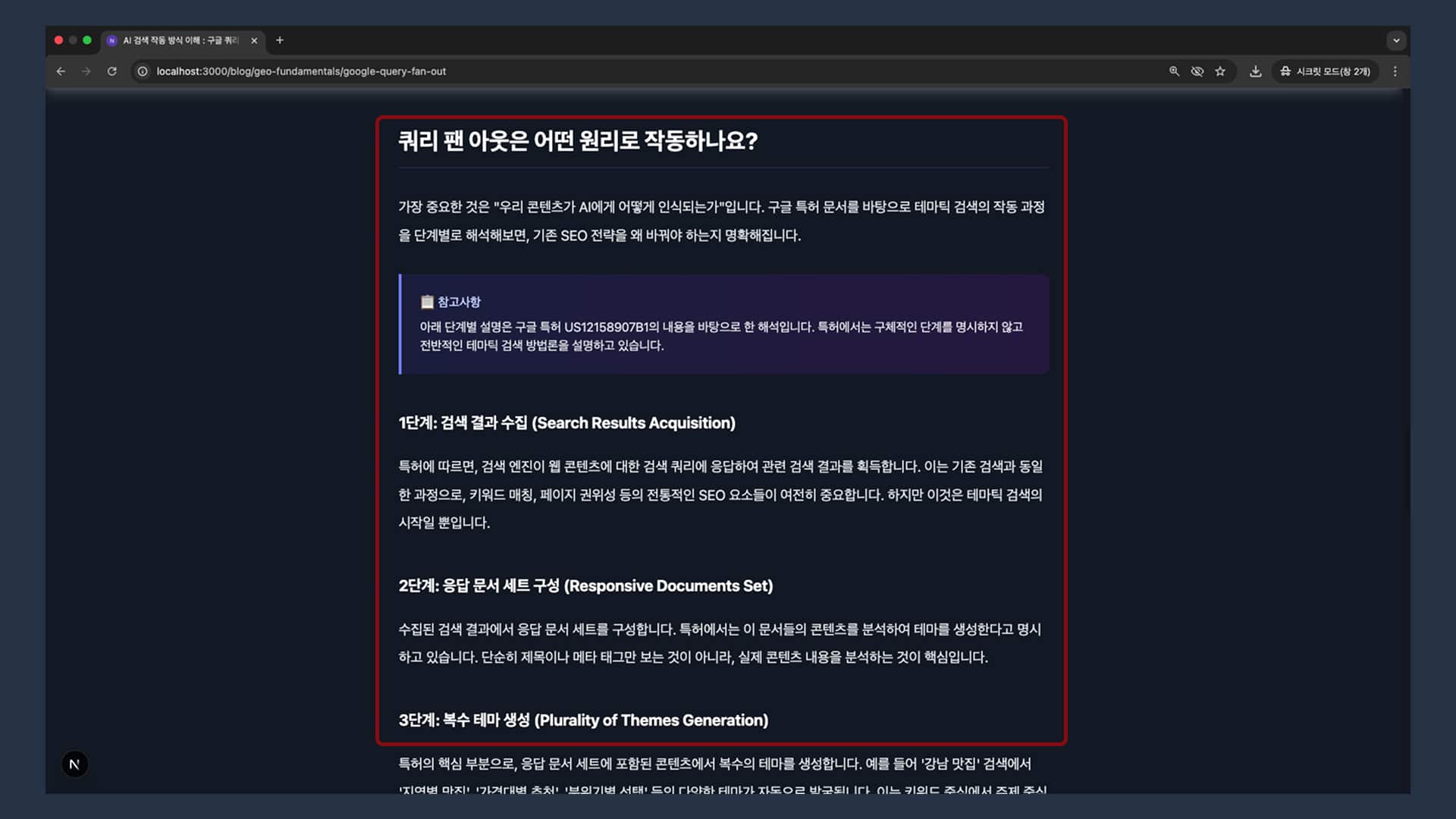
Technical Terminology to Strengthen Expertise - Answer Global Application Example
Original link: AI Search Mechanism Analysis: An Easy and Professional Explanation of Query Fan-Out Technology
Key Summary of Content Strategy for GEO Optimization
The most important thing in content optimization strategy for the AI search era is clearly understanding the differences between SEO and GEO. When structuring blog categories, rather than comprehensively covering topics with different characteristics, categories should be organized with deeply related topics that can provide rich answers to a single search query. (Example: T-Direct Shop Galaxy S26 Content) This allows achieving both thematic consistency and comprehensiveness of content.
Next, strategies verified through reliable research should be applied to actual content creation. Systematically utilize quantitative statistics (+41%), expert quotes (+40%), credible source citations (+28%), easy-to-read natural writing style (+25%), and technical terminology (+15%), while definitely avoiding artificial keyword stuffing (-9%).
We hope this article helps with your content strategy planning for the AI search era. The Answer Global team will continue to bring you more useful GEO-related content.
Author Profile
.png&w=256&q=75&dpl=dpl_HxR7hWjDdqUKcNFr3Q1F2TV2BGzN)
Ozzy
CMO / Senior GEO Consultant
Experience
- •CMO at Answer, Head of GEO Consulting Division (2025–present)
- •Led GEO projects for major Korean enterprises across Electronics, Automotive, Finance, and Beauty industries
- •Validated brand recommendation strategies in ChatGPT, Gemini, and Perplexity
- •Founded and operated Narr Enterprise — specialized SEO/GEO consulting service