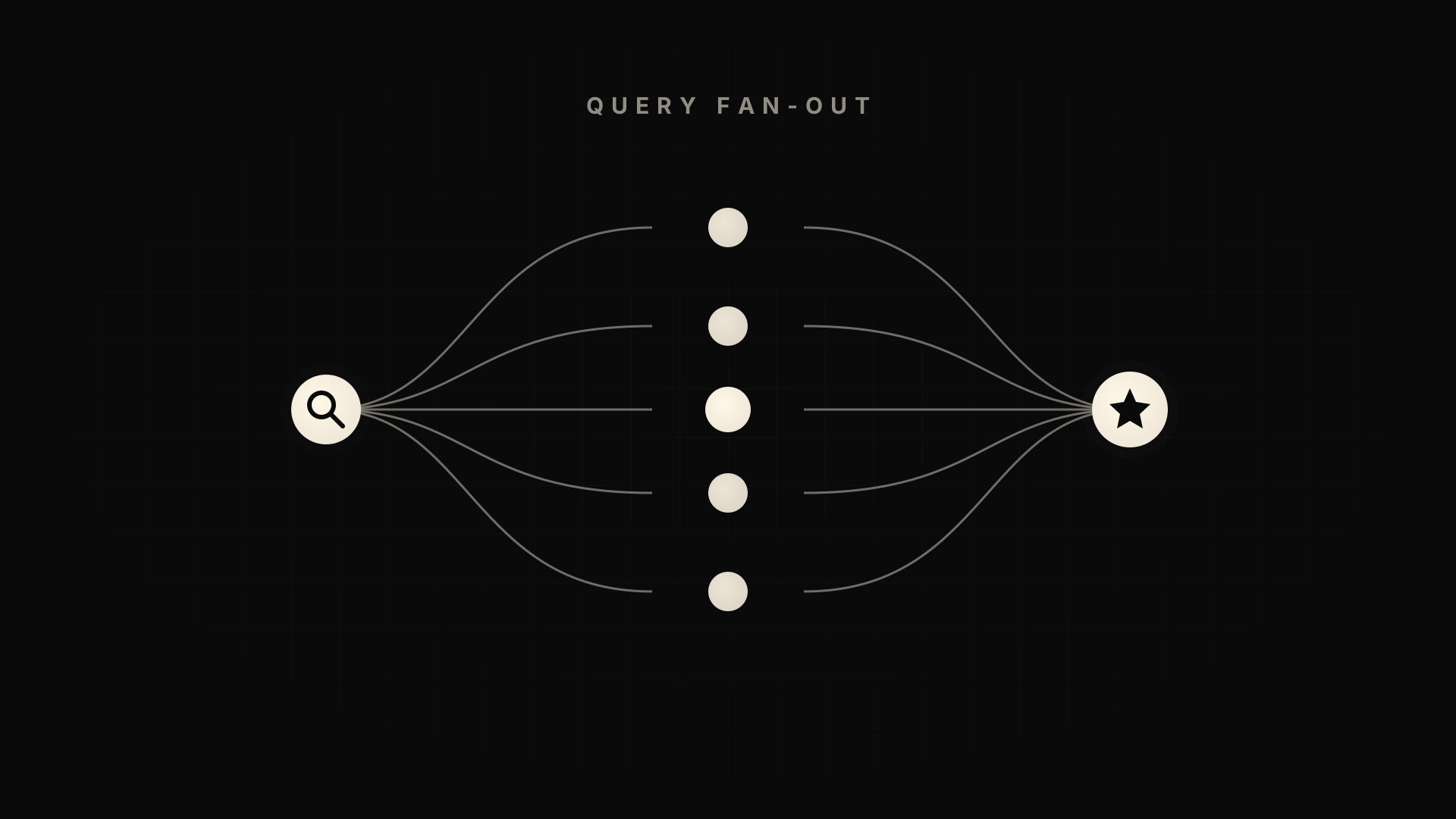
AI Search Mechanism Analysis: An Easy and Professional Explanation of Query Fan-Out Technology
Until now, SEO strategy for top website rankings has involved selecting target keywords and publishing content optimized for that single keyword. For example, to rank first for 'Gangnam restaurants,' you would write content optimized for that keyword, build backlinks, and improve technical SEO.
But now, with the emergence of AI search, the 'rules of the game' have completely changed. Based on Google's latest patent document US12158907B1 and Google's published search AI mode update document, we'll explain 'how Google AI search works' from a practical perspective.
What is Query Fan-Out?
Have you ever used AI search and thought, "Wow, it's telling me things I didn't even ask about?" Our team uses AI search most during the planning stage because AI presents perspectives we hadn't considered. The technology enabling this experience is Google's 'Query Fan-Out,' which we'll discuss in this article.
According to Google patent US12158907B1 'THEMATIC SEARCH,' the thematic search engine is an innovative method where "in response to a search query for web content, a search engine obtains search results related to the search query and generates a plurality of themes from the search results including a set of responsive documents." Each theme "includes a respective phrase describing that theme," thereby "providing thematic data to browser applications."
Simply put, AI 'fans out' one search query into multiple related topics to gather materials. For example, if a customer searches for 'Gangnam restaurants,' AI simultaneously searches all related topics like 'Gangnam Korean restaurants,' 'Gangnam date courses,' 'Gangnam lunch menus,' 'Gangnam company dinner spots,' and more.
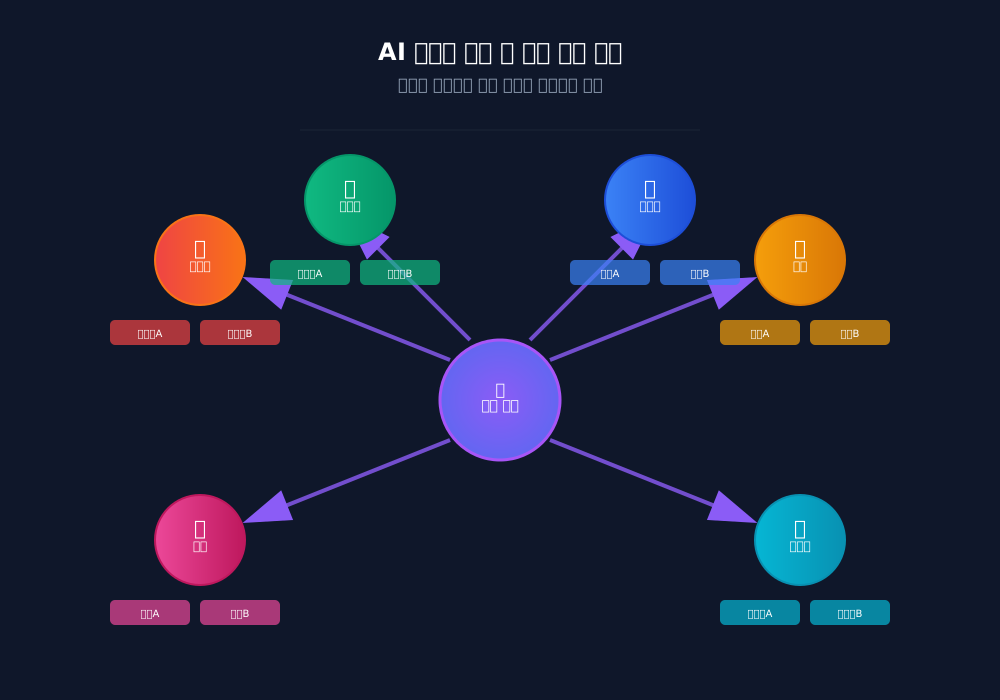
How AI Search Query Fan-Out Works
This is a completely different approach from traditional search, which simply matched only the 'Gangnam restaurants' keyword. Now we must consider not a single keyword but the 'entire topic ecosystem.'
In fact, this query fan-out technology is already familiar to us. According to Google's 2025 I/O, Google Gemini Deep Research utilizes this very technology.
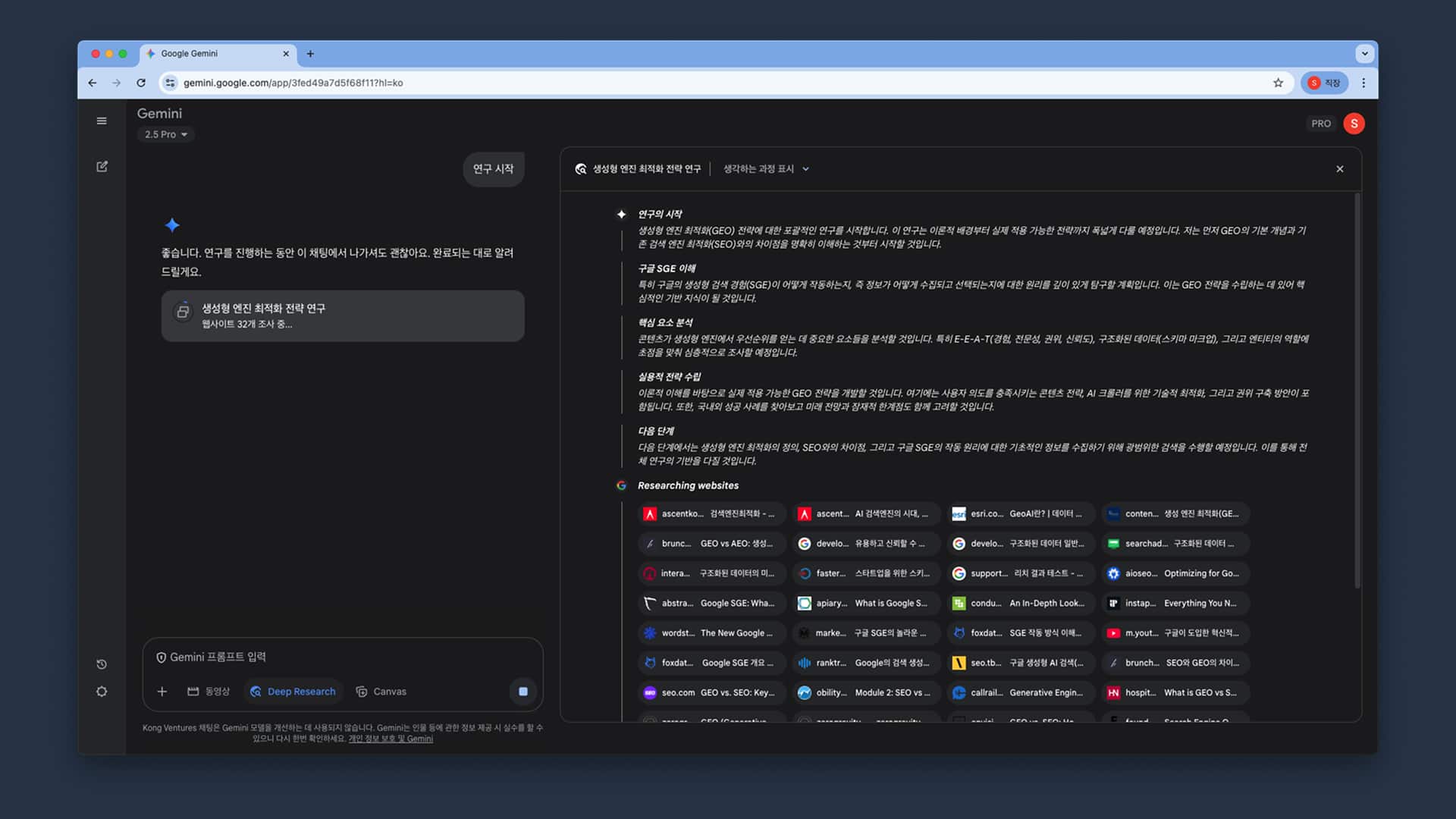
Google Gemini Deep Research in action
Google Gemini Deep Research takes the same 'query fan-out' technology one step further, performing hundreds of queries simultaneously, comprehensively analyzing different information, and generating expert-level reports with references in just minutes.
Google Patent US12158907B1 Key Content
Patent Name: THEMATIC SEARCH
Registration Date: December 3, 2024
Inventors: Jamie Leach, Danielle Fisher, Jason Blythe, Mahsan Rofouei, Sundeep Tirumalareddy, Zhaoyang Xu, Eric Lehman
Source: https://patents.google.com/patent/US12158907B1/en
This patent describes in detail the technical methodology of "generating a plurality of themes from the content contained in the set of responsive documents, each theme including a respective phrase describing that theme."
How Does Query Fan-Out Work?
The most important thing is "how is our content perceived by AI?" When we interpret the thematic search operating process step by step based on the Google patent document, it becomes clear why we need to change our existing SEO strategy.
Note
The step-by-step explanation below is an interpretation based on the content of Google patent US12158907B1. The patent does not specify concrete steps but explains the overall thematic search methodology.
Step 1: Search Results Acquisition
According to the patent, the search engine obtains related search results in response to search queries for web content. This is the same process as traditional search, where traditional SEO factors like keyword matching and page authority remain important. However, this is just the beginning of thematic search.
Step 2: Responsive Documents Set Formation
A responsive documents set is formed from the collected search results. The patent specifies that themes are generated by analyzing the content of these documents. The key is analyzing actual content rather than just titles or meta tags.
Step 3: Plurality of Themes Generation
This is the core part of the patent, where a plurality of themes is generated from the content in the responsive documents set. For example, from a 'Gangnam restaurants' search, various themes like 'restaurants by area,' 'recommendations by price range,' and 'choices by atmosphere' are automatically discovered. This represents a paradigm shift from keyword-centric to topic-centric.
Step 4: Respective Phrase Description Generation
According to the patent, each theme includes a respective phrase describing that theme. This is the stage of expressing themes in user-friendly form. Our content must have the expertise and clarity to be selected as the representative description for a specific theme.
Step 5: Thematic Data Provision
Finally, thematic data is provided to browser applications on client devices. This data includes a plurality of themes and thematic search results. Users can now explore information more efficiently through structured topic-based information using a single search query.
What Are the Differences from Traditional Keyword-Centric Search?
The most tangible change is that the 'rules of the game' have completely changed. Traditional search primarily relied on keyword matching between user input and webpage text, backlink analysis, and site authority. Search engines simply judged "how relevant is this document to the search query?" and listed results by relevance. However, query fan-out proactively reorganizes information as AI understands the actual meaning of content and predicts users' potential interests. This means a completely new approach is needed.
The Biggest Change
Before, you just needed to rank first for the 'Gangnam restaurants' keyword. Now you must be recognized as an expert on all topics related to 'Gangnam restaurants' (restaurants by area, recommendations by price range, choices by atmosphere, menu types, etc.). This is because search results have evolved from simple relevance-ordered listings to structured topic-based exploration tools. Users can now simultaneously explore information from multiple perspectives with a single search query, and we face a new environment where we must plan content considering all related topics that AI can discover, not just a single keyword.
How Are Topic Priorities Determined in Google Query Fan-Out?
This is probably the most curious part. "For which topic can our content be selected as first priority?" According to the Google patent, theme order is not arbitrarily determined but decided by a systematic ranking algorithm. The system comprehensively evaluates each theme's relevance, quality, and alignment with user intent.
Particularly important is how closely related each theme is to the original search query. For example, in a 'Gangnam restaurants' search, 'restaurants by area' would have high relevance while 'Gangnam real estate' would have relatively low relevance. We now need to consider thematic consistency and comprehensiveness beyond simple keyword optimization. It's time to check whether we're providing content deep enough to be truly recognized as experts in the topics we're targeting.
References
Primary Sources
- [1] Leach, J., Fisher, D., Blythe, J., Rofouei, M., Tirumalareddy, S., Xu, Z., & Lehman, E. (2024). Thematic Search. U.S. Patent No. 12,158,907 B1. U.S. Patent and Trademark Office.https://patents.google.com/patent/US12158907B1/en
- [2] Google Korea Blog.Google Search AI Mode Update.https://blog.google/intl/ko-kr/products/explore-get-answers/google-search-ai-mode-update-kr/
Author Profile
.png&w=256&q=75&dpl=dpl_HxR7hWjDdqUKcNFr3Q1F2TV2BGzN)
Ozzy
CMO / Senior GEO Consultant
Experience
- •CMO at Answer, Head of GEO Consulting Division (2025–present)
- •Led GEO projects for major Korean enterprises across Electronics, Automotive, Finance, and Beauty industries
- •Validated brand recommendation strategies in ChatGPT, Gemini, and Perplexity
- •Founded and operated Narr Enterprise — specialized SEO/GEO consulting service