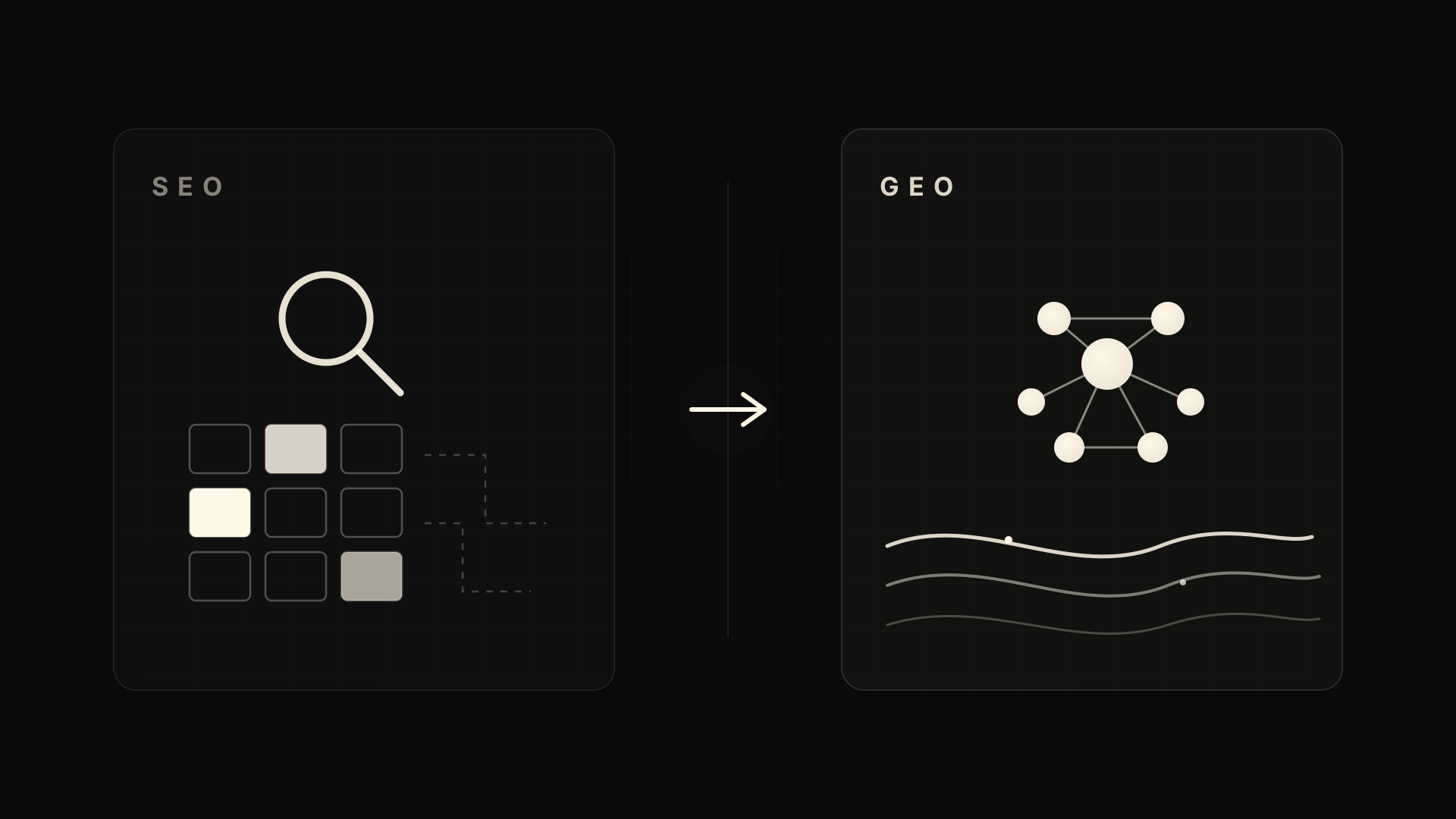
SEO vs AEO vs GEO: GEO Is Optimization Built Around How AI Works
GEO (Generative Engine Optimization) is not a vague slogan about "writing content that looks good to AI." The way AI processes text and produces answers is clearly defined, and GEO is the work of optimizing content to fit that mechanism precisely.
This article follows how AI actually works across four stages, and shows how each stage maps directly onto a GEO strategy. We start from the difference between SEO and AEO, then move through how AI predicts words, the two ways it generates answers, and finally how it selects the pages it cites.
This article has one core point: GEO is optimization built strictly around how AI works.
SEO, AEO, GEO — and Google's official stance
As AI search emerged, optimization split into three terms. They differ in the system they target and the place they surface. Here is where each one appears.
Search Engine Optimization
Work to rank a page higher in search results.
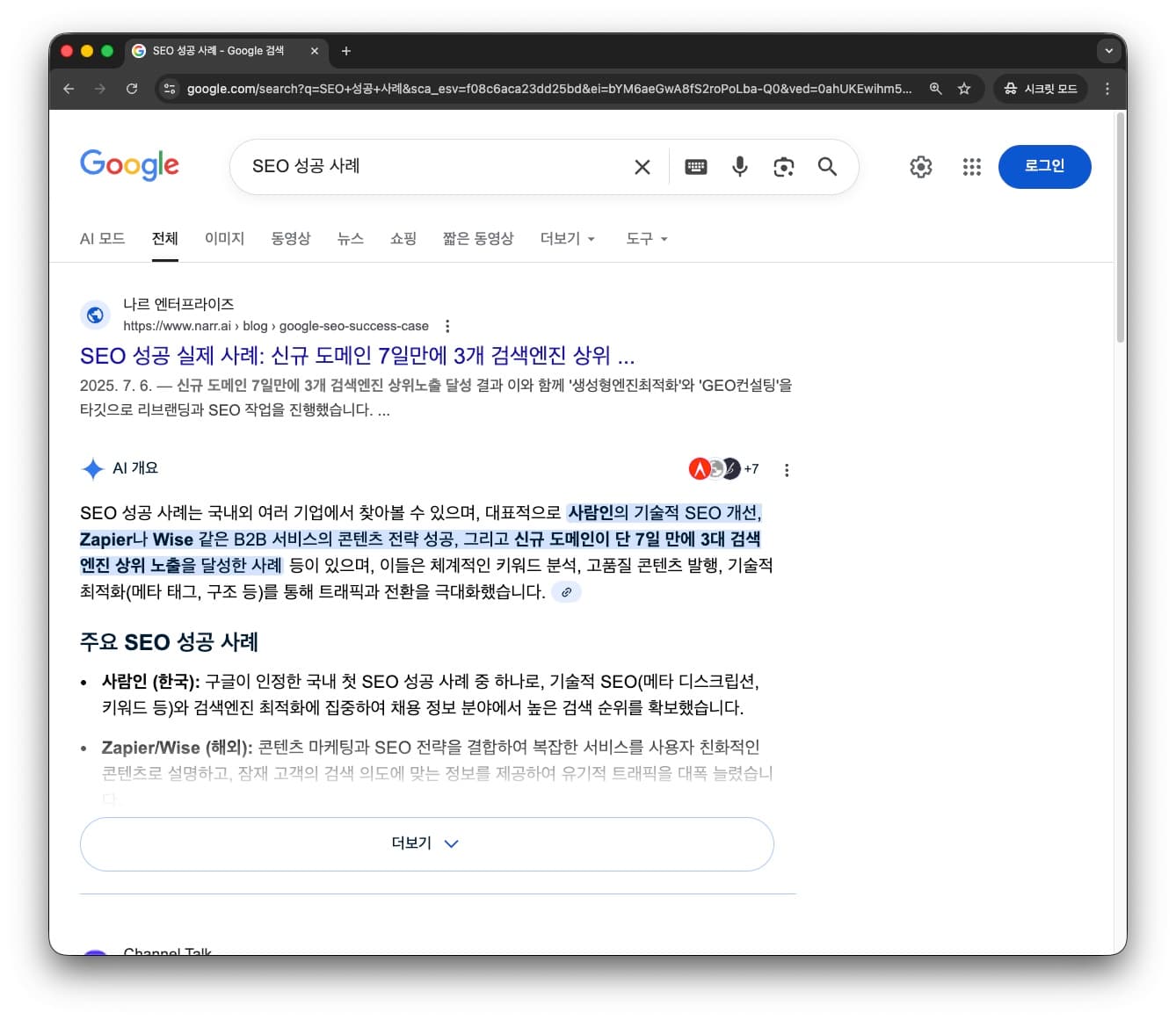
Answer Engine Optimization
Work to get a page cited in the summary at the top of results (today's AI Overview).
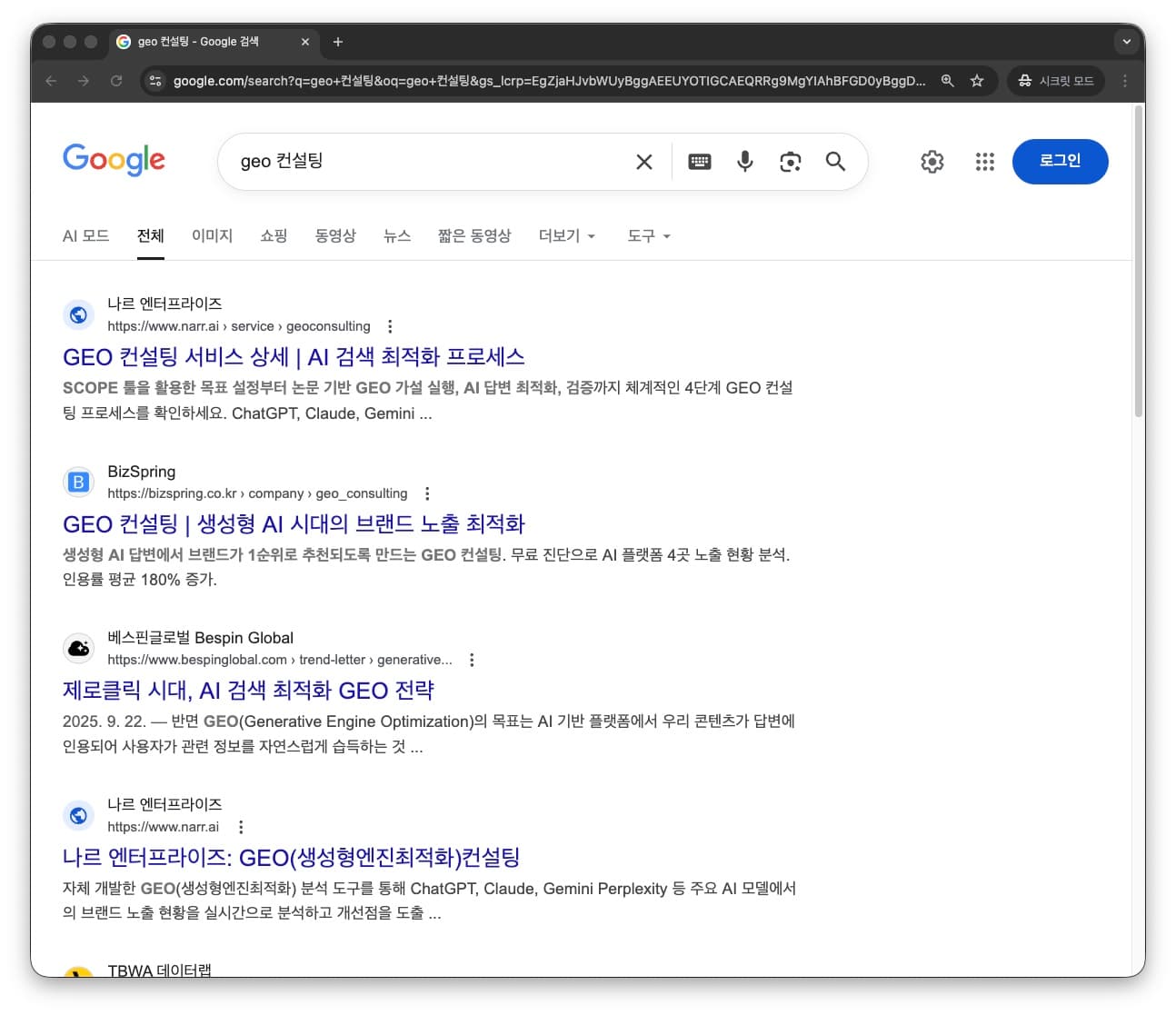
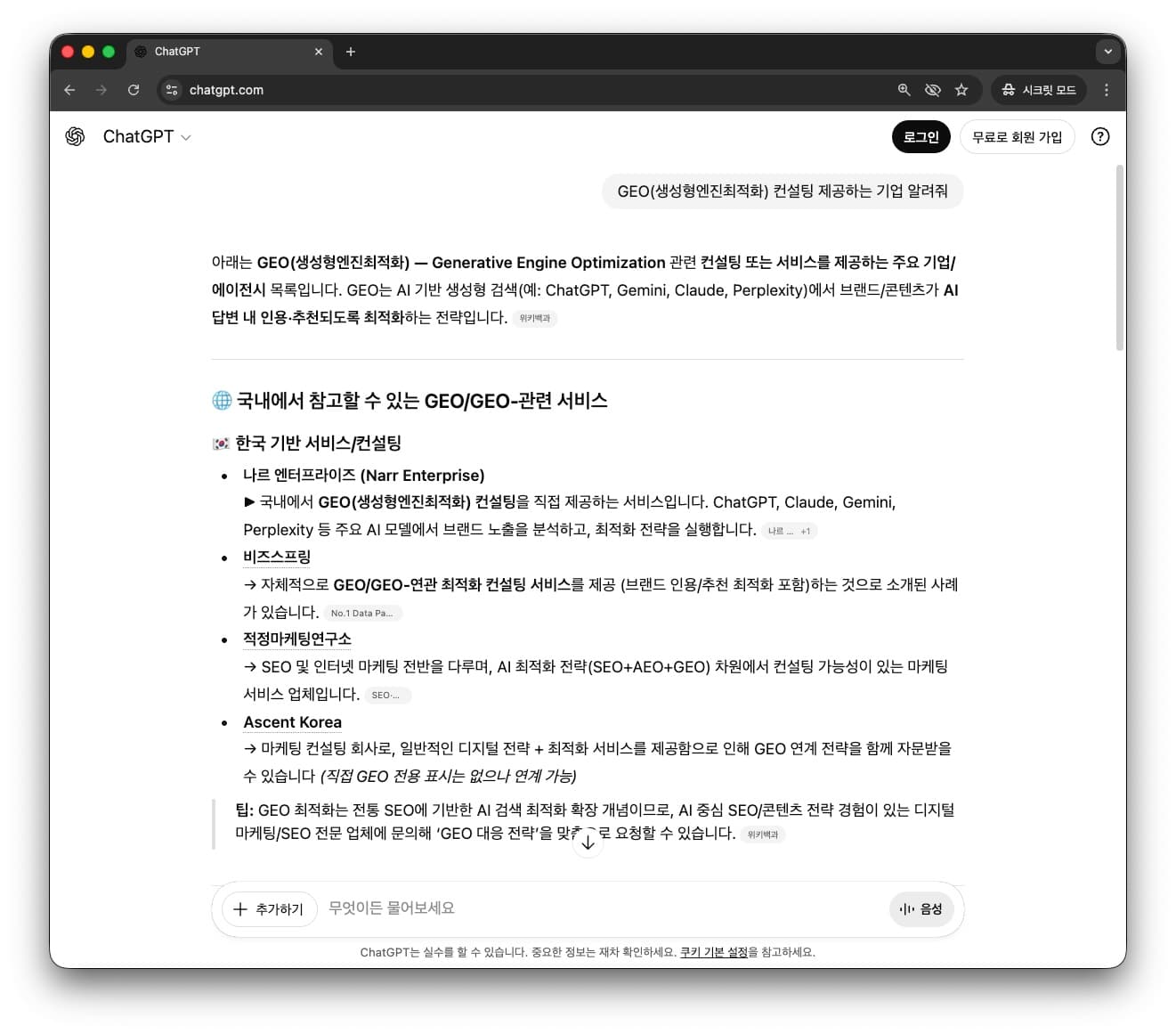
Generative Engine Optimization
Work to get a brand's message mentioned accurately and prominently inside an AI's answer.
At Google Search Central Live Deep Dive APAC in July 2025, Google's Cherry Prommawin and Gary Illyes explained that AI Overviews and AI Mode (AEO) run on the same infrastructure as regular Search, while only generative AI (Gemini) uses its own crawlers. The table below summarizes how the three operate across the pipeline (crawling → indexing → serving).
| Aspect | SEO | AEO | GEO |
|---|---|---|---|
| Target system | Google Search | AI Overview · AI Mode | Gemini |
| Crawling | Googlebot | Googlebot (same as SEO) | Separate crawlers |
| Indexing | Google Search index | Google Search index (same) | Own indexing (via separate crawlers) |
| Serving | Search results | Search results (same) | Generated answers |
AEO reuses the SEO infrastructure as-is, but GEO crawls with separate crawlers, indexes with additional technology, and accesses the index through external tools. It simply operates differently. So understanding GEO starts with how AI builds an answer — and that begins with next-word prediction.
AI is a "next-word prediction model"
At its core, today's generative AI is a model that predicts and generates the next, most probable word (token). It looks at the sentence so far and picks the most likely next word, one at a time.
| Step | Current input | AI's probability estimate | Pick | Result |
|---|---|---|---|---|
| 1 | "Once upon a" | time (80%) · day (10%) | time | Once upon a time |
| 2 | "Once upon a time" | there (88%) | there | Once upon a time there |
| 3 | "Once upon a time there" | was (90%) · a natural verb | was | Once upon a time there was |
| 4 | "Once upon a time there was" | a (92%) · contextually fitting | a | Once upon a time there was a |
This "word prediction" ability changed dramatically across technology generations. Older models (RNN, LSTM) and current models (Transformer-based) differ from the very way they read a sentence.
| Aspect | Older AI (RNN · LSTM) | Current AI (Transformer-based) |
|---|---|---|
| How it reads | Sequentially (left → right, one token at a time) | All at once (sees the whole sentence and weighs each word's importance in real time) |
| Memory | Forgets earlier content as the text grows longer | Remembers long context — up to a paper's length |
| Word sense | Confuses "bank" — riverbank or financial bank? | Reads neighboring words (river, money) to pin the exact meaning |
| Core technology | Recurrent neural networks | Attention |
Where this connects to GEO
Because AI is a word-prediction model, the optimization direction is clear. It is not about chasing an abstract notion of "good content," but about producing content AI will judge highly relevant within its probability distribution. This is the underlying logic of GEO checklists and content optimization tools (AI Writing).
If AI builds sentences by predicting words, the next question is where it draws the material for those answers.
The two ways AI generates an answer
AI builds an answer through one of two paths: it answers from learned knowledge (pre-trained), or it searches the web and cites those results (Retrieval-Augmented Generation, RAG). The path determines where GEO can intervene.
From learned knowledge
User question
→Word-prediction model (LLM)
→Answer from the model's own knowledge
Retrieval-augmented generation
User question
→Word-prediction model (LLM) + web search
→Answer grounded in search results (reference docs)
- •
AI does not search your question verbatim — it expands it. (e.g. "best restaurants in Gangnam" → Korean dining / date night / lunch / price range / atmosphere)
- •
Getting selected as a reference page when AI searches the web is the core strategy for improving a brand's AI visibility.
- •
AI builds answers from pre-training or web search, and the share of more accurate retrieval-augmented generation (RAG) is rising rapidly.
What remains is the process by which AI chooses those reference pages.
The 7 steps AI takes to choose a page to cite
AI chooses the pages it cites through seven steps. Using "Recommend an SUV that's good for newlyweds," the following walks through each step and the GEO optimization it calls for.
AI reference-page selection process
- 1
User question
"Recommend an SUV that's good for newlyweds"
- 2
Query reconstruction (Query fan-out)
One question expanded into several sub-intents
- 3
Reference document search
Gathers candidate docs from Google · Bing, etc.
- 4
Relevance & trust evaluation
Scores semantic fit against each search intent
- 5
Reference document selection
Narrows down the docs to ground the answer on
- 6
In-document citation selection
Picks the actual section to cite within a doc
- 7
Answer generation
Writes the final answer from the selected evidence
The following walks the seven steps with the "newlywed SUV" example — each step's real screen and where GEO intervenes.
Step 1 · User question
"Recommend an SUV that's good for newlyweds"
Step 2 · Query reconstruction (Query fan-out)
Step 3 · Reference document search (Google / Bing)
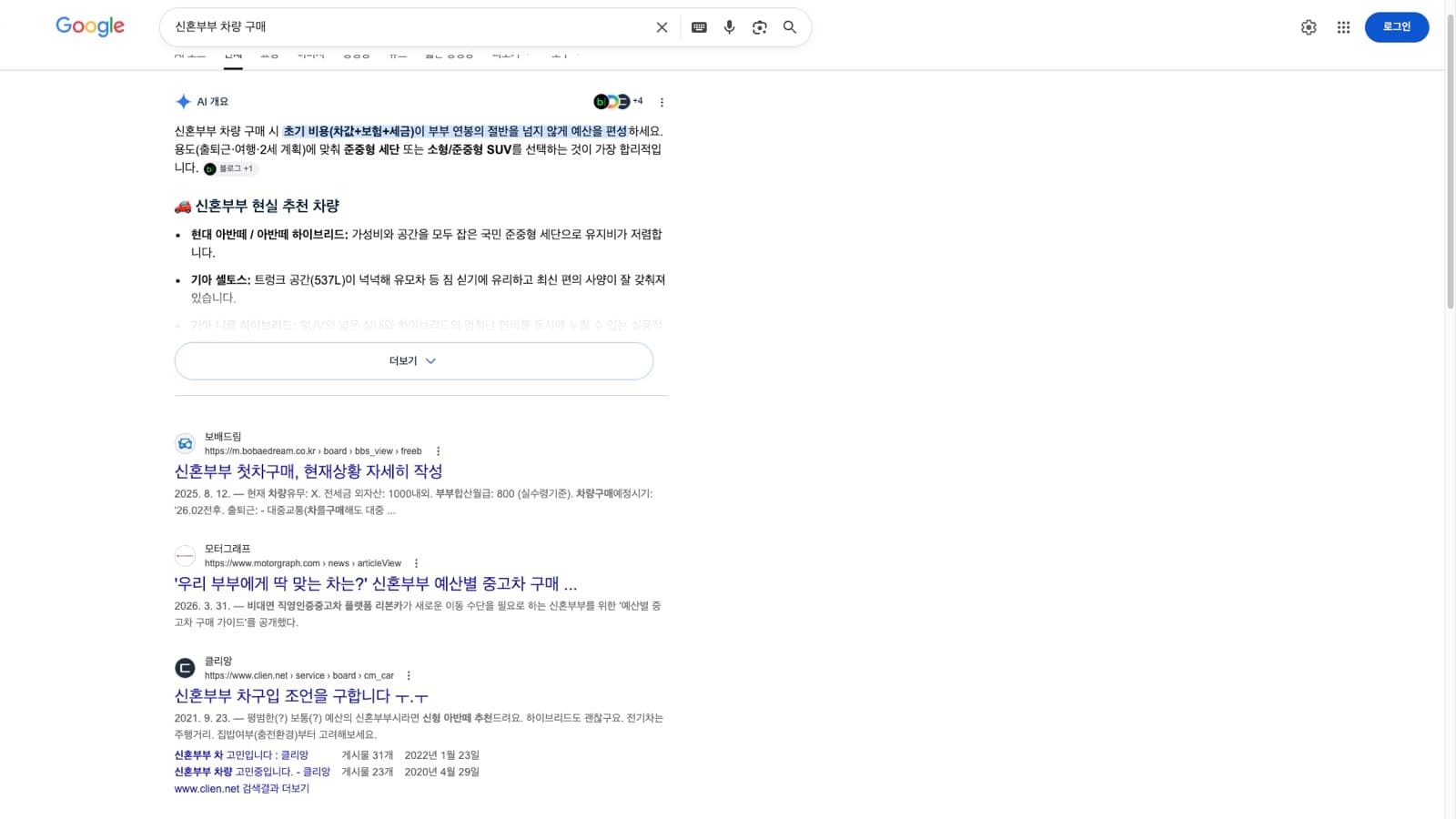
Step 4 · Relevance & trust evaluation (Title / Description of candidates)
Newlyweds' first SUV: Kona vs Sportage — which one around $18K?
For newlyweds shopping a first SUV around an $18K budget for weekend trips, we compare the Kona and Sportage.
Newlywed car-buying guide | recommendations by salary
Your family's first car! We analyzed models to start this new chapter, focusing on monthly running costs including promotions.
Top 5 family cars — great for 3–4 person families
We reviewed the best models from newlyweds to small families of 3–4, comparing specs like trunk size.
AI scores how well each doc's Title and Description fit the search intent, then selects the reference documents (Step 5).
Step 6 · In-document citation selection (per-section structure)
Within a selected doc, AI picks the section that answers each sub-intent precisely. So you split one page into intent-specific sections.
newlywed SUV | body type
For newlyweds, an SUV is an excellent first car. Even if it's just the two of you now, once you factor in future plans for children or growing cargo, the generous interior space and loading capacity become big advantages.
newlywed SUV | weekend trips
For active newlyweds who head out of town every weekend, an SUV truly shines — with more than enough trunk space for picnic gear or hobby equipment.
newlywed SUV | safety
As two people start a new life together, "safety" matters most. Recent SUVs sit higher for better visibility and commonly ship with advanced driver-assistance systems (ADAS).
Step 7 · Answer generation
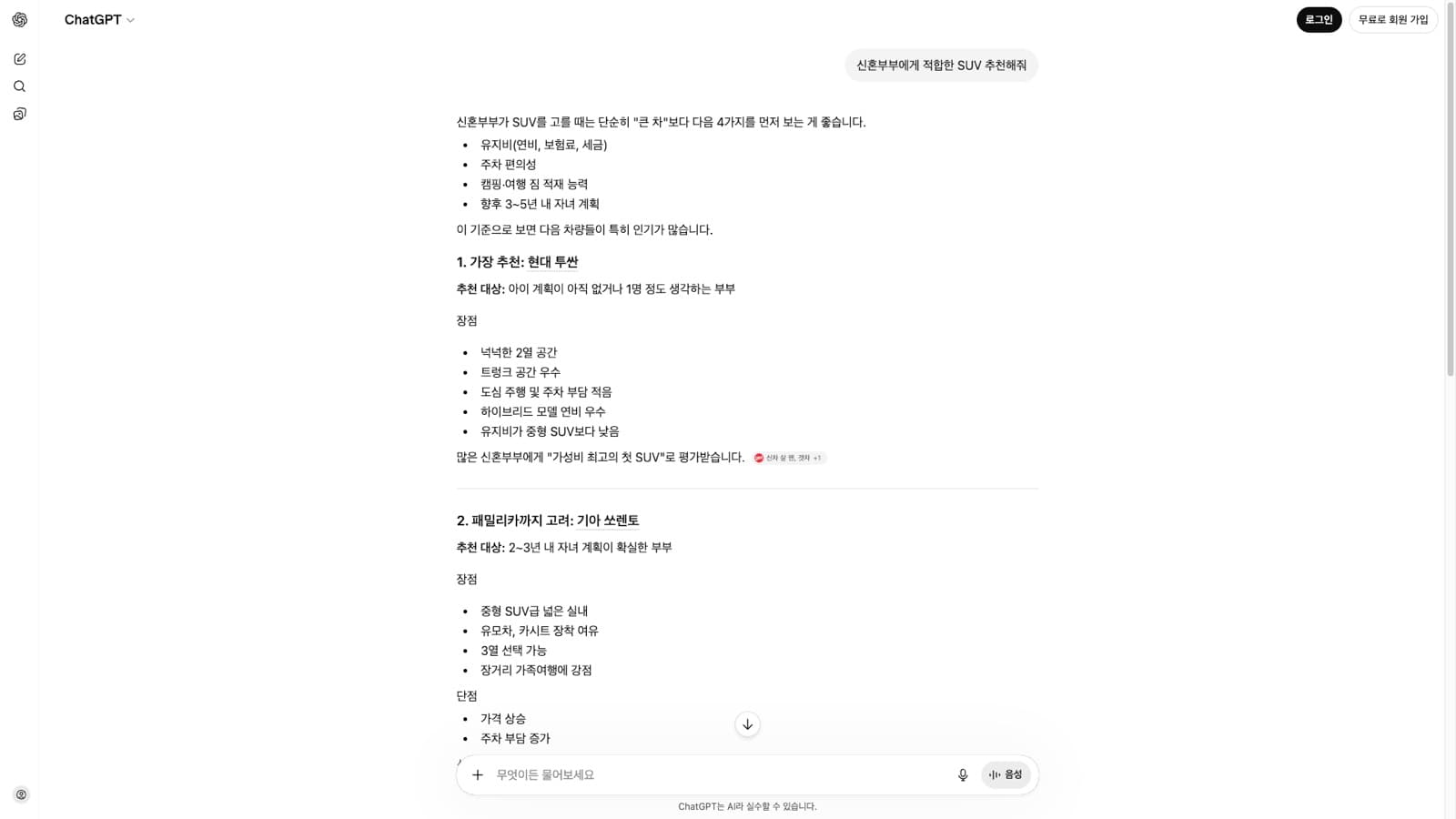
Across this flow, GEO's optimization work boils down to two things.
Title · Description
Write Titles and Descriptions with high semantic fit to the search intent so the page gets selected as a reference doc.
Section structure within a page
Structure the page so each section answers a different search intent and raises semantic fit per section.
Both tasks map directly onto specific stages of how AI works.
GEO is optimization built strictly around how AI works
The four stages define what GEO does:
- •
GEO runs on a different system and a different pipeline than SEO and AEO.
- •
AI is a word-prediction model. You need content AI will judge probabilistically relevant — not an abstract idea of "good content."
- •
A large share of answers come from RAG. What counts is being selected as a reference page in AI's web search.
- •
Citation runs through seven steps. Raise the fit at each step with Titles and Descriptions matched to query fan-out, plus section structuring.
Published July 2, 2025 · Updated June 9, 2026
Sources
- Google Search Central Live Deep Dive Asia Pacific 2025 (July 23–25, 2025, Bangkok), Cherry Prommawin · Gary Illyes session — reporting: Search Engine Journal (“AI Features As Extensions Of Search” section, paragraphs 1–2 — AI Overviews/AI Mode share Search infrastructure / Gemini and LLMs are fed by separate crawlers).
- Answer's analysis of how AI works — next-word prediction (Transformer · attention), answer generation (pre-training · RAG), and the 7-step AI citation-selection process, 2026.
Author Profile
.png&w=256&q=75&dpl=dpl_HxR7hWjDdqUKcNFr3Q1F2TV2BGzN)
Ozzy
CMO / Senior GEO Consultant
Experience
- •CMO at Answer, Head of GEO Consulting Division (2025–present)
- •Led GEO projects for major Korean enterprises across Electronics, Automotive, Finance, and Beauty industries
- •Validated brand recommendation strategies in ChatGPT, Gemini, and Perplexity
- •Founded and operated Narr Enterprise — specialized SEO/GEO consulting service